What Happens to Your Money if Rivo Shuts Down? Jiko Custody, Account Ownership, and Access Explained
If Rivo shuts down, your T-bill investments do not become Rivo corporate assets. Learn how Jiko custody, account ownership, access, SIPC, and cancellation work.
.png)
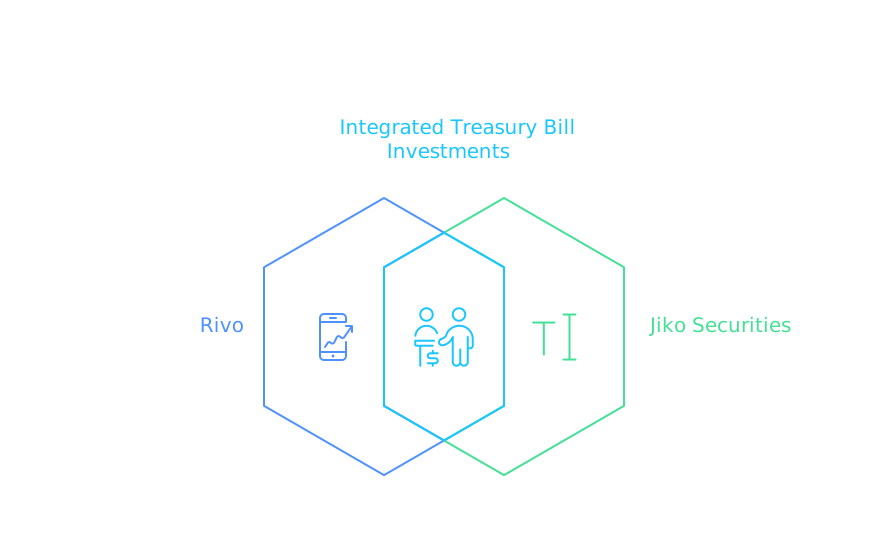
If Rivo shuts down, your Treasury Bill investments do not simply become Rivo corporate property. Rivo is the software and automation layer. Your brokerage relationship, account ownership records, cash, and U.S. Treasury securities are handled through regulated financial partners, including Jiko Securities.
That separation is the most important fact in this article. It does not mean every hypothetical shutdown would be instant or frictionless. An app outage, an orderly product closure, a Rivo corporate failure, and a Jiko brokerage failure are different events. The access path, processing time, and instructions would depend on what actually happened.
The practical answer is therefore conditional:
- If only the Rivo app is temporarily unavailable, the outage does not by itself change who owns the assets recorded in the Jiko brokerage account.
- If Rivo ends the service in an orderly way, the current cancellation process returns funds to the linked bank account, stops active automations, and preserves account-history access.
- If Rivo as a company becomes unavailable, the regulated account and custody structure matters because Rivo is not the broker-dealer holding the Treasury positions.
- If Jiko Securities fails, the relevant framework is brokerage customer protection, including SIPC protection and its limits, not a promise from the Rivo app.
This guide explains what each layer does, what current public documents support, what they do not guarantee, and what records you should keep before any service disruption occurs.
TL;DR
- Rivo is a technology company, not a bank or broker-dealer. Banking services are provided by Jiko Bank, and U.S. Treasury investments and investment advisory services are provided by Jiko Securities, a registered broker-dealer and SIPC member.
- Jiko's brokerage agreement identifies the person in its records as the account owner. It also explains that customer funds and securities are recorded on Jiko's books and held at a custodian through an omnibus structure under the brokerage agreement.
- A Rivo shutdown and a Jiko Securities failure are not the same event. Rivo operates the product experience and automation; Jiko handles the brokerage account and custody relationship.
- SIPC can protect securities and eligible cash at a failed SIPC-member brokerage up to $500,000, including up to $250,000 for cash claims. SIPC does not protect market losses, promised returns, or every type of delay.
- Current Rivo account controls let you pause Autopilot, cancel the service, return funds to your linked bank, and retain access to account history through the cancellation workflow.
- No article can promise the exact timeline or interface that would apply during a hypothetical shutdown. Keep statements and trade records, maintain access to your linked bank and verified contact information, and follow official instructions from Rivo, Jiko, FINRA, or SIPC if an actual event occurs.
.svg)
Quick Answer: Would You Lose Your Money if Rivo Closed?
The ownership answer
Rivo closing would not automatically mean your money disappeared. The customer asset structure is deliberately separated from Rivo's corporate operating account.
Rivo provides the software that analyzes cash flow, applies your settings, displays activity, and initiates the product workflow. Jiko Securities provides the brokerage account through which Treasury Bills are purchased and held. The Jiko brokerage agreement states that the person identified in Jiko's records is the owner of the securities account.
The access answer
This distinction changes the failure question:
The takeaway is not "nothing can go wrong." The takeaway is that the software company, bank, broker-dealer, custodian, linked checking account, and underlying Treasury securities are separate parts of the system. You need to identify which part is affected before choosing the right response.
What Does Rivo Control, and What Does Jiko Control?
Rivo operates the software layer
The easiest way to understand shutdown risk is to separate the operating roles.
Rivo controls the customer-facing cash-management experience. You connect a checking account, configure a minimum balance, review planned movements, see earnings, and manage Autopilot through Rivo. Rivo uses the account information and settings needed to coordinate cash movement.
Jiko operates the regulated account layer
Jiko provides the regulated bank and brokerage infrastructure. The public Rivo disclosure identifies Jiko Bank as the banking provider and Jiko Securities as the provider of U.S. Treasury investments and investment advisory services.
Your existing bank remains the checking-account provider. Bills, direct deposit, debit activity, and ordinary checking transactions continue through that bank.
This is why What Is Rivo? describes Rivo as an automation layer rather than a bank replacement. The product can coordinate money across the system without being every institution in the system
How Is Ownership Recorded if the Custodian Uses an Omnibus Account?
The customer remains the account owner of record
Ownership and custody are related, but they are not identical.
The Jiko retail brokerage agreement says that only the person identified in Jiko's records is considered the owner of the securities account. The agreement also says that funds and securities are recorded on Jiko's books and records and held at the custodian in an account in Jiko's name together with assets of other customers.
Omnibus custody depends on accurate broker records
That second structure is commonly called omnibus custody. It can sound confusing because the custodian-level account may not display each customer name on the external account title. The broker-dealer's books and records allocate the positions to individual customer accounts.
The practical implication is important: do not treat the Rivo screen as your only evidence. Keep the available Jiko statements, tax forms, trade confirmations, and Rivo account history. Investor.gov advises investors to retain account statements and trade confirmations because those records help establish transaction and ownership history when questions arise.
What Happens During a Temporary Rivo App Outage?
What stays true during an outage
A temporary app outage is primarily an access and operations problem. It is not automatically an ownership event.
If the Rivo app or website is unavailable, you may be unable to view balances, change the safe balance, pause automation, request a withdrawal, or see the latest status through the normal interface. That matters, especially if a bill or unusual expense is approaching.
What can still break operationally
The brokerage records do not vanish merely because the front end is offline. Jiko's account agreement and records remain the stronger evidence of the brokerage relationship. However, an outage can still create operational uncertainty around pending instructions, notifications, liquidations, and transfers.
Do not solve an access problem by initiating multiple duplicate requests. Repeated withdrawal or transfer attempts can create more reconciliation work when service returns.
What an Orderly Rivo Closure Would Look Like
The current exit path
An orderly closure is different from a sudden corporate failure. In an orderly closure, customers would normally receive instructions, a deadline, and a process for stopping automation and returning funds.
The current Rivo cancellation workflow provides the closest public operating reference. When you cancel, funds are returned to the linked bank account, active automations stop, and account-history access remains available.
What the current process does not guarantee
That does not prove every future service closure would use an identical timeline. It does show the current product has an exit path that does not require customers to keep Autopilot running indefinitely.
An orderly sequence would generally involve these functions:
- Stop new automated movements.
- Resolve or cancel pending instructions where possible.
- Liquidate Treasury positions as needed to create transfer proceeds.
- Settle the resulting transactions.
- Transfer available cash to the verified linked bank account.
- Preserve account statements, tax documents, and required records.
The sequence above is a functional illustration, not a promised Rivo shutdown procedure. Exact steps would depend on account agreements, market status, pending transactions, legal requirements, and instructions from the regulated partners.
What Happens if Rivo Suddenly Becomes Unavailable?
Start with the institution that actually failed
A sudden Rivo failure would make communication and access more complicated, but the custody structure still matters.
Rivo's corporate failure would not by itself turn Jiko customer assets into Rivo operating cash. The assets are handled through the bank and brokerage relationships described in the Rivo legal disclosures and Jiko brokerage agreement.
Answer the operational questions before acting
The likely operational questions would be:
- Is Jiko Securities still operating normally?
- Can customers access account information through a Jiko-supported path?
- Are any trades, liquidations, or transfers pending?
- Which customer communication is authenticated and official?
- What documents prove the customer identity and account?
- Does a regulator, trustee, or service administrator provide new instructions?
The answer can change depending on the event.
This is also why the phrase "Rivo is not the custodian" is useful but incomplete. It reduces one form of corporate balance-sheet exposure, but it does not eliminate operational, vendor, cybersecurity, market, settlement, or communication risk.
What Happens to Active Treasury Bills and Available Cash
Treasury positions may remain invested or be sold
The answer depends on the asset's current state.
A customer account can contain Treasury positions, cash awaiting investment, cash generated by a maturity or sale, and money already moving through bank-transfer rails. Each state has a different operational path.
The Jiko risk disclosure explains that Treasury positions may be held to maturity. It also explains that positions may be sold before maturity when a transfer or withdrawal requires proceeds. An early sale can affect realized yield and value.
Cash and transfers follow a different path
The safe assumption is not that every position will instantly arrive in checking. The safer assumption is that transactions still follow liquidation, settlement, identity verification, and bank-transfer processes unless official instructions state otherwise.
Whether SIPC Protects You if Rivo Shuts Down
When SIPC becomes relevant
Not merely because Rivo shuts down.
SIPC is designed for customers of a failed SIPC-member brokerage. Jiko Securities is identified as a SIPC member in Rivo's public product disclosure and in Jiko's Treasury risk disclosure.
SIPC explains that it can protect securities and eligible cash in a failed member brokerage up to $500,000, including up to $250,000 for cash claims. The customer may need to follow a formal claims process when SIPC steps in.
What SIPC does not cover
SIPC does not mean:
- every app outage creates a claim,
- every delayed transfer is insured,
- the market value of a Treasury security is guaranteed,
- a promised yield is protected,
- every type of cash held anywhere in the product has identical coverage,
- or customers receive instant payment after a brokerage failure.
The core rule is simple: identify the failing institution. Rivo is the software company. Jiko Securities is the SIPC-member broker-dealer.
Whether FDIC Insurance Is the Relevant Protection
FDIC applies to eligible bank deposits
FDIC insurance and SIPC protection cover different relationships.
FDIC insurance applies to eligible deposits at an insured bank, subject to its rules and limits. SIPC applies to eligible customer cash and securities at a failed SIPC-member brokerage, subject to a different legal framework.
Treasury holdings use the securities framework
Treasury Bills held through the brokerage are securities. They are not FDIC-insured bank deposits. The required product disclosure is direct: "Investments in T-bills: Not FDIC Insured. No Bank Guarantee. May Lose Value."
For the broader safety comparison, read Are Treasury Bills Safe for Short-Term Cash?. That article explains why "government-backed," "SIPC-protected," and "FDIC-insured" are not interchangeable labels.
What Risks Remain Even When Assets Are Held Through Jiko?
Structural separation is meaningful
Custody separation solves only part of the risk question.
The Jiko Treasury risk disclosure identifies market, interest-rate, operational, systems, cybersecurity, vendor, counterparty, and process risks. It also states that risk controls and business-continuity plans have inherent limits.
Operational limits still matter
The practical point is not to distrust the structure. It is to understand what the structure can and cannot do. Regulated custody, customer records, and SIPC membership are meaningful protections. They are not a promise that every unusual event will be invisible to the customer.
Canceling Rivo vs. Rivo Shutting Down
Cancellation is a user-directed, supported workflow. A shutdown is a company or service event that may affect many customers at once.
When you cancel under the current account-management process, active automations stop, funds are returned to the linked bank account, and account-history access remains. You initiate the process while the product and support systems are operating.
In a shutdown:
- the company may set the timing,
- normal app controls may be limited,
- communications may arrive through several regulated entities,
- pending transactions may need reconciliation,
- and a trustee, regulator, broker-dealer, or service administrator may control parts of the process.
Do not cancel solely because a hypothetical shutdown is imaginable. Every financial provider has operational and corporate risk. Use the product only if the actual structure, controls, return profile, and risks fit your needs.
Records to Keep Before Anything Goes Wrong
Keep enough information to prove identity, ownership, activity, and the destination bank without depending on a single app.
Investor.gov recommends keeping brokerage statements and trade confirmations and reviewing them for accuracy as part of basic investor recordkeeping.
Use this record checklist:
- Latest Rivo account summary and transaction history.
- Latest Jiko brokerage statement available to you.
- Trade confirmations or activity records for Treasury purchases, sales, and maturities.
- Tax forms issued through the product.
- The masked identity of the linked checking account.
- Copies of material support conversations.
- The current Rivo terms, Jiko account agreement, and Treasury risk disclosure.
- Verified contact details for Rivo and Jiko.
Do not store full account credentials in an unsecured note. The goal is to preserve account evidence, not create a new security problem.
Account records are also useful when the problem is much smaller than a shutdown. A transfer can be delayed, a tax form can use the regulated partner's name, or a displayed balance can differ from the latest settled activity. A statement and trade confirmation let support teams investigate the specific transaction instead of reconstructing the account from memory.
Review the legal name on the brokerage record, the linked-bank identifier, and your current email and phone information while the service is working normally. If any field is wrong, correct it before you need an urgent withdrawal or account recovery. The best incident plan starts with accurate records and verified contact details, not with a response improvised after access is lost.
What to Do If You Can't Access Rivo or Your Funds
Start by identifying whether the problem is login access, a pending transfer, an unavailable balance, a brokerage issue, or a bank issue.
Then use a controlled sequence:
- Confirm that you are using the official Rivo app or website.
- Check the linked bank for pending or completed transactions.
- Save the error, date, account identifier, and relevant amount.
- Contact Rivo through the published support channel.
- If the issue concerns the brokerage account, follow verified Jiko instructions and confirm the firm through FINRA BrokerCheck.
- If an actual brokerage liquidation occurs, follow the trustee and SIPC claims instructions.
- If you believe there is fraud, unauthorized activity, or identity theft, contact the relevant financial institutions and authorities promptly.
Avoid acting on an unsolicited message that asks for credentials, remote access, a cryptocurrency payment, or a transfer to a "safe account." A real shutdown or outage often creates opportunities for impersonation.
For ordinary liquidity, current product controls allow withdrawal of available funds through the app up to $15,000 per day. That product limit is not a shutdown recovery guarantee. If you have a known large payment, keep the required amount in checking before the payment becomes urgent.
How to Evaluate Rivo Before Connecting
The shutdown question is one part of a broader product-fit decision.
You should be comfortable with:
- Rivo operating as the software layer rather than the custodian,
- Jiko handling the bank and brokerage relationships,
- Treasury Bills being securities rather than FDIC-insured deposits,
- SIPC having specific conditions and limits,
- money movement requiring processing and settlement,
- and the possibility of temporary app, vendor, bank, or brokerage disruption.
If you are still mapping the full product lifecycle, read How Does Rivo Autopilot Work?. If the main question is whether your existing bank relationship changes, read Does Rivo Replace Your Bank?.
Final Answer: What Happens to Your Money if Rivo Shuts Down?
Your money does not automatically become Rivo's money if Rivo shuts down.
Rivo is the software and automation layer. Jiko Securities provides the brokerage account, maintains the customer account relationship and records, and supports the Treasury transactions and custody structure. Jiko's agreement identifies the customer in its records as the account owner.
The exact access path would depend on the event:
- An app outage calls for support, transaction verification, and temporary cash-flow caution.
- An orderly Rivo closure should use the product's cancellation and return workflow.
- A sudden Rivo failure would require official instructions from Rivo, Jiko, and potentially regulators or an administrator.
- A Jiko Securities failure would raise the separate SIPC customer-protection process.
The right standard is not "Can anyone promise that every shutdown will be painless?" No responsible provider can make that promise. The right standard is "Are customer ownership, custody, records, controls, and protection boundaries clear before I connect?"
For Rivo, the key protections are structural separation, a regulated broker-dealer relationship, customer ownership records, account controls, and defined SIPC coverage. The key limitations are operational access, settlement timing, market risk, cyber and vendor risk, and the fact that SIPC is not FDIC insurance or market-loss protection.
FAQ
Do I lose my Treasury Bills if Rivo goes out of business?
Not automatically. Rivo is not the broker-dealer that maintains the Treasury account. Jiko Securities provides the brokerage relationship, and the Jiko account agreement identifies the person in its records as the account owner. The actual access or transfer process would depend on the event and official instructions.
Who legally owns the Treasury positions used by Rivo?
The Jiko brokerage agreement says the person identified in its records is the owner of the securities account. It also explains that funds and securities are recorded on Jiko's books and held at a custodian through an omnibus account. Rivo does not custody the Treasury positions as its own corporate assets. Keep statements and confirmations that connect your identity to those records. This article is not legal advice, and the treatment of any specific insolvency depends on contracts, facts, and applicable law.
Is SIPC the same as FDIC insurance?
No. SIPC protects eligible cash and securities at a failed SIPC-member brokerage, subject to conditions and limits. It does not protect market loss. FDIC insurance applies to eligible deposits at an insured bank under a separate framework.
What if the Rivo app is down when I need money?
Check the linked bank, preserve the error and transaction details, and use the official Rivo support channel. Do not submit repeated duplicate transfers. For known urgent payments, keep enough cash in checking rather than relying on a last-minute liquidation or transfer.
Can I cancel Rivo before a shutdown happens?
You can cancel at any time under the current account-management workflow. Current product details state that funds are returned to the linked bank account, active automations stop, and account-history access remains.
What is the most important document to keep?
Keep the latest brokerage statement, plus trade confirmations and Rivo account history. Together, they help establish the account owner, positions, transactions, and movement instructions. Investor.gov recommends retaining statements and trade confirmations for brokerage recordkeeping.
Related Rivo Reading
- To understand the product and partner structure, read What Is Rivo?.
- To compare Treasury, FDIC, and SIPC protections, read Are Treasury Bills Safe for Short-Term Cash?.
- To follow the complete setup, sweep, refill, and withdrawal lifecycle, read How Does Rivo Autopilot Work?.
- To see what changes and what stays at your existing bank, read Does Rivo Replace Your Bank?.
- To understand the ordinary available-funds, T-bill-sale, settlement, and return-to-checking workflow, read How Do Rivo Withdrawals Work?.

This article is educational and is not financial, investment, tax, accounting, or legal advice.
Yield rate reflects the 4-week T-bill rate when held to maturity. Rate does not include fees. Rates are subject to change. Minimum balance of $100 is required to earn the stated rate.
Rivo is a fintech company, not a bank. Banking services provided by Jiko Bank, a division of Mid-Central National Bank. Jiko Group, Inc. and its affiliates do not provide legal, tax, or accounting advice. You should consult your legal and/or tax advisors before making any financial decisions. This material is not intended as a recommendation, offer or solicitation for the purchase or sale of any security or investment strategy. See FINRA BrokerCheck, Jiko U.S. Treasuries Risk Disclosures and Jiko Securities Inc. Form CRS.
Investments in T-bills: Not FDIC Insured - No Bank Guarantee - May Lose Value. All U.S. treasury investments and investment advisory services provided by Jiko Securities, Inc., a registered broker-dealer, member FINRA and SIPC. Securities in your account are protected up to $500,000. For details, please see www.sipc.org.
SIPC protection is subject to eligibility, legal limits, account capacity, and the facts of a brokerage failure. SIPC does not protect market losses or promised investment performance.
Sources
- Rivo homepage and regulated-partner disclosures
- Rivo account management, cancellation, liquidity, and support
- Rivo Terms of Service
- Jiko Securities Retail Brokerage and Advisory Account Agreement
- Jiko U.S. Treasuries Risk Disclosures
- FINRA BrokerCheck: Jiko Securities
- SIPC: What SIPC Is and What It Protects
- Investor.gov: Broker-Dealer Record-Keeping Requirements

Shalu Yadav is Rivo's SEO/GEO Expert, bringing over 10 years of experience in making financial content discoverable across both classic search and generative AI platforms.
Follow on LinkedInGet Rivo Updates
Product news, money insights, and company updates.